Showing posts with label piano practice. Show all posts

Sunday, January 20, 2019

Parenting Tip - How to be a Student

I'm in my late 60s, but I'm a student.
I teach piano and ukulele lessons, but I'm a student.
I've already graduated from college and completed a music endorsement, but I'm a student.

I'm a student because I'm taking mandolin lessons (I'm on week 3!)
I'm a student and just enrolled in a gardening course.
I'm a student and taking a fabric art class.

But there are many other areas where I'm a student, too.
I'm a student because I'm still learning from my children and grandchildren.
I'm a student because I'm still practicing things like learning not to judge and how to have faith.
I'm a student of the scriptures and learning new things each day I study them.

I bet if you looked at your life, you would realize you're a student too!

Sometimes it's fun to be a student.  I love to learn and accomplish new things.  It's fun to learn to play a new song on the mandolin.  Other times, it's not really fun being a student.  Not when I cower in fear or uncertainty instead of exercising faith.

It's easy to say, "Well, I'm just a student, that's why my efforts were not the best.  That's why I was wrong and goofed up."  or "Hey, what do you expect? I"m just learning?"

However, being a student-- a really good student---means there are certain requirements we need to fill, certain repetitions we need to perform, and a certain amount of time needed in order to acquire our new skill.

As a teacher, I tell my music students to practice slowly and play the notes correctly so their brain understands what to do.  I tell them to play a short section of their song many times in a row, perhaps 5-10 repetitions. I tell them to watch their fingering and do it correctly each time so their muscle memory can help them later on.

As a mandolin student I play the G scale on my mandolin over and over again.  My teacher says it's important to use the pick correctly, so I play slow and carefully.   I'm making progress but I wonder if I'll ever be good enough to play fast.

My teachers are kind and encouraging, both in my music, gardening and fabric art classes. There are some days when I can almost hear God, the Supreme Teacher, talking to me and encouraging me.  "Cathy, be slow and careful in how you want to judge that person."  "Cathy, I know you've read your scriptures countless times, read them again and pay attention this time."  "Cathy, you may not think you're making progress, but you are, hang in there!"

I'm a student for life-- learning and progressing one step and one day at a time. I will take it slowly, practice carefully and correctly, and enjoy each little success along my path.


Wednesday, October 25, 2017

Parenting Tip - Is Your Child an Upholder, Obliger, Questioner or Rebel (read as Strong-willed)?

I really like many of the books Gretchen Rubin has written, but I’m obsessed with her newest book, The Four Tendencies.
This is what she says about it on her website:
During my multibook investigation into human nature, I realized that by asking the suspiciously simple question “How do I respond to expectations?” we gain explosive self-knowledge.
I discovered that people fit into Four Tendencies: Upholders, Questioners, Obligers, and Rebels. Our Tendency shapes every aspect of our behavior, so understanding this framework lets us make better decisions, meet deadlines, suffer less stress and burnout, and engage more effectively. The Four Tendencies explain why we act and why we don’t act.
I am an Obliger (you can take a quick quiz here to find out what tendency you are ).  Knowing this has made my life easier.  I understand why I do some of the things I do and know how to deal with other aspects of my life, like accomplishing goals or saying no to people.  I think it is important to understand our family members and realize their tendencies—especially our spouses and children.  It can make family life so much more enjoyable when we understand why people act and respond the way they do.  Then we can change the way we approach our spouse or child so we can have win-win experiences and less conflicts.

Here are the Tendencies in a nutshell:
The Upholder Tendency
Upholders are those people who readily respond to outer and inner expectations alike.   They meet work or school deadlines as well as keep goals they set for themselves.
Strengths:  Upholders can set goals and ideals for themselves and stick to it.  They follow rules. They also fulfill expectations that others have for them.  They love schedules and routines.  They like to know what is expected of them and don’t like to make mistakes.
Weaknesses:  Upholders don’t like to have their schedules changed.  They are uncomfortable if they can’t follow the rules or expectations teachers or others have put on them.  They want to follow them whether they are sensible or not. They don’t like change and can be inflexible and rigid.
Dealing with an Upholder Child
Parents may enjoy having children who are Upholders because they don’t have to nag them about doing homework or practicing the piano. They plan ahead and have their softball equipment ready and like to arrive at school on time or even early.

The Upholder child doesn’t like to change his schedule.  If he needs to read 30 minutes a day for school he has a hard time letting that go if a busy day prohibits it. He has a hard time letting a task go not quite completed such as a book report project he feels he needs more time on.

Be careful about unintentionally adding an expectation or suggesting unnecessary rules.  An upholder child will exert a lot of energy toward trying to meet it.  The author states that an offhand remark like, “you should enter the spelling bee” might set off an unintended stressful chain reaction.

In dealing with an Upholder child, address his tendency value: “You like to do things that are expected of you”, “you like to be on time”, or “you like to finish your projects”.  But then address the issue in a logical way such as, “your teacher will understand that you can only read 15 minutes on some days”, or “it’s more important to go the speed limit and be safe than to be extra early to school”.

The Questioner Tendency
We all have inner expectations—things we want to do, and outer expectations—what others want us to do.  Questioners only do things that are inner expectations and only those outer expectations that they have turned into inner expectations.  Questioners want information, logic and efficiency.  They want to gather the facts and decide for themselves if something is legitimate to do, the best thing to buy, or the right thing to follow. They like logical conclusions and will research options until they are convinced.
Strengths:  Once Questioners are resolved to do something, they follow through and are reliable. They don’t just accept the traditional way to do things, so may come up with new solutions to problems or situations.
Weaknesses:  When Questioners don’t accept the justification for an expectation, they refuse to meet it.  Rules may seem arbitrary or make no sense.  When wanting to purchase an item, they may research and question so much, they can’t come to a conclusion and make a decision.

Dealing with a Questioner Child
A child who is a questioner does not accept phrases like, “because I said so”, or that’s the rule”. Questioners want to understand the “why” of doing something, and once they do, they are more willing to comply.  Why is piano practicing important?  Why should I learn the multiplication tables? Why does my school require uniforms?

Parents or teachers who are dealing with a child’s refusal to do something should find out why the child is refusing, then help the child understand the reasons behind the issue.  Help him find the justification for doing what he doesn’t want to do.  Why do I have to sit in my car seat?   Because it’s the law and you don’t want Mommy to have to pay a fine.  Why do I have to eat my vegetables?  Because they will make you healthy and strong so you can hit a home run some day.

The Obliger Tendency
Throughout a day, week and month, people are always asking us to do things.  The Obliger can accomplish things someone else asks her to do, but has a hard time meeting expectations that only she puts on herself.  For example, when you were in school, you could meet your English deadlines, but now you have a hard time consistently writing in your journal.

Obligers needs accountability.  Someone who is expecting them to bring them the results they’ve asked for.  If you are on a team and training for a game, you don’t want to let your teammates down, so you run every morning.  But after the season is over, you can’t get yourself to run anymore.  The accountability has disappeared.
Strengths:  Obligers get things done!  They volunteer, help out, and meet deadlines.  They make great leaders, team members, friends and family members.
Weaknesses:  Obligers have a hard time meeting their own needs and desires.  They need to feel accountable to someone in order to meet the goals they’ve set for themselves.  This is my tendency.  I used to always announce to my children that I would give them $10 if they saw me eat any more cookies the rest of the day.  Then it was easy for me to not eat any more.

If Obligers get overwhelmed by constant demands they are trying to meet of others, they can have a meltdown—which is usually not pretty.  They go into Obliger-Rebellion and resist doing anything.   Family members need to be aware of Obligers in their home, and help them not get overwhelmed, by helping them say “no” when necessary.  They can also provide accountability to help them reach their goals.

Dealing with an Obliger Child
I was delighted to read the author’s example when dealing with an Obliger child (which she says is sometimes hard to pick out).  She gave the example of piano practicing and said there needs to be accountability like having a practice chart, a parent’s gentle reminder or a teacher who says, “I can tell if you’ve been practicing or not.”

Help your Obliger child create accountability by enrolling him in classes, making job charts, having family rules, etc.  But be aware so your child does not begin feeling overwhelmed by meeting everyone’s needs but his own.

The Rebel Tendency
Rebels don’t want anyone telling them what to do, including themselves! They resist all efforts when someone asks them to do something and have a hard time getting themselves to do something they want to do.  For Rebels, being able to choose and have freedom of self-expression is vitally important. They respond better to people asking their opinion rather than being told to do something.
Strengths:  They don’t cave into peer pressure.  They enjoy meeting challenges especially when someone says it will be too hard to do. Rebels do things their way and want their lives to exhibit their values.
Weaknesses:  Rebels don’t like to be told to do something and resist commands and control over themselves.  They want to do things in their own way and in their own time.  They have a hard time sticking to a schedule.

Dealing with a Rebel Child (my daughter prefers to call them Strong-willed children and I agree)
Strong-willed children are hard to deal with. They want to make their own choices.  The best way to handle them is to give them information, tell them what the consequences are, and let them make their choice. And don’t watch them—then they think there is an expectation and will rebel and not choose.
Strong-willed children need to feel the consequence of their choices, be it good or bad. Strong-willed  children are motivated by identity.  Explain the situation:  “When you’re always late and delay our leaving, I feel like I can’t trust you.  Do you want to be trustworthy or not--your choice."  Make things fun for the strong-willed child.  Make up games when you’re brushing your child’s teeth or sing silly songs.  Strong-willed children like challenges: “Bet you can’t get dressed before Daddy does”.  Let them choose: “You can eat a snack, do your homework now, and then play before dinner or you can eat a snack and play first.  But if you don’t finish your homework before dinner, you will have to finish it after dinner and not have time for me to play a game with you before bedtime.  It’s your choice.” Then allow them time and space to make their choice.

In reviewing how to deal with children in these four tendencies, it seems to me that parents should use lots of common sense.  It shouldn’t be a nerve wrecking decision trying to decide what is the correct thing to say to your obliger child compared to what to say to your strong -willed child.  Good parenting  techniques cover all types and personalities of children.  In summary, here are some basic, sound ideas that work well in dealing with any and all types of children:

1.       Explain the situation to your child when a conflict arises.  Appeal to his sense of value.
2.       Listen to your child to understand what his needs are that are not being met.
3.       Explain the “why” behind rules and “why” you are asking for a certain behavior from your child.
4.       Make charts and give positive reinforcement to help establish new habits and outcomes.
5.       Give information, consequences and choice to your child.
6.       Let your child suffer the consequences of his choice and actions.
7.       Have fun with your child, make up games and challenges to spice up daily routines.

I hope this information has been helpful.  Now apply it to your spouse!

Thanks for reading,

Cathy
******************************************************************************


Wednesday, March 23, 2016

Music Tip - Popular 4 chord Songs

I've been teaching my piano students chord inversions to prepare them for playing the 4 chord songs I've been giving them.  My pre-teen and teen piano students are loving them--the songs, not the chord inversions!

For some students, I give them just the chords for hands alone until they are comfortable playing them--usually one week--then I give them the whole song.  For other students, I give them the whole song, but first have them play the chords, hands alone, so they can understand the chord progression.  I also reinforce the correct fingering and point out that it is always the 2nd inversion (for the left hand) that changes and uses the 2nd finger instead of the 3rd finger.

The whole point to these songs is to show a simple 4 chord progression that is repeated throughout the song, thus making the song EASY to learn and FUN to play.  It "hooks" my reluctant learners. 

"Piano Man" is a popular song that I give my students first.  I teach the left hand chords, then I play the melody while they play the chords.  This gets them interested in learning both hands, plus, if they're not familiar already with the melody, it helps them learn what it sounds like. The first week all they practice are the left hand chord progressions, which sound pretty cool and they all come back playing them really well.

The second week I play the melody while they play the left hand again, just to reinforce the song/melody.  Then I have them play just the melody line by themselves.  Next I play the left hand chords while they play the melody.  Dueting a song is SO IMPORTANT because it helps the student hear how the left and right hand coordinate the sounds together. Finally, I have them play both hands together.  This whole process takes about 5-8 minutes of their lesson time. They go home and practice both hands together and whola, when they come back the next week, it always sounds pretty darn good!  I can tell they have practiced--which is my aim!

By the way, did I mention I have been using my smart phone during piano lessons a lot?  I use it to introduce a popular song I want my student to learn to play.  I play the song on you tube (finding appropriate views, first) so they can get interested in the song.  Sometimes they've heard it before and sometimes they haven't, but hey, getting to watch a you tube cover song during piano lessons is a real grabber and motivator for my students!

Here is my arrangement of "Piano Man".  Enjoy!!

Thanks for reading, offer any suggestions you might have on the music.
Cathy

******************************************************************************

Thursday, September 24, 2015

Music Tip - Fun Chord Progressions

I've been giving my piano students chord progressions.  I love them, and my students seem to like them too-- anyway when they come back to lessons I can tell they've been practicing them.  You may know about the popular 4 chord progression made popular by Axis of Awesome.  These four chords I V vi IV are used in more than 70 different popular songs.  In the key of C major, this would be: C–G–Am–F.  When you play the chords one right after another, they make a pleasing musical phrase that you can improvise melodies above.

Recently I gave the following chord progression to my students, but I can't remember which website I got it from.  It might have been Tim Topham, a popular Australian pianist/teacher/speaker.  The progression is:
Am/a  G/a  F/a  G/a        
Am/f  G/f  F/f  G/f
Am/d  G/d  F/d  G/d
Dm/b  EM/e  Am/a.

The capital letters represent the chord played with the right hand- four times in a row.
The lower case letter after the slash is the left hand note, played one time.
(So Am/a means right hand plays the notes A,C,E as a block chord four times in a row while the left hand plays an A on the piano with just the first time the chord is played.  Then the right hand plays GBD four times with the left hand again playing an A, etc)
One of my boy students said, "That sounds like the music to Rocky."  He was hooked, of course.

The next week after giving my students this chord progression, I gave them a number of different ways to try playing it at home during their practice time.  Here are some different ways to play it:
* Have the right hand play a broken chord instead of block chords.
* Have the left hand play a rhythm on it's note during the chords instead of just playing the note one time per chord group.
* Play the chord progressions in a different octave on the piano.  Playing it up high sounds like a music box.
* Use different dynamics during the progression.
* Add the pedal - in fact, this is an excellent way to introduce how to play the pedal correctly.
* Improvise a melody above the chord progression.  I would demonstrate by improvising a melody as the student played the chord progression, then I asked the student to improvise a melody.  I told them to use stepping or skipping steps on the notes in the chord I was playing.

Another chord progression my students have enjoyed is from Jon Schmidt's (from The Piano Guys) song he wrote way back when he was in high school.  He based it off a tuna commercial.  The song is called, The Dumb Song, and that really appeals to students. The link will take you to a pdf of the song.

I teach just the left hand of the first page.  Then the next week I add the simple right hand single notes.  Depending on the ability of the student, I eventually have them add block chords for the right hand and/or inversions.  This is a great way to teach students about chord inversions.

Teaching my students to play and have fun with chord progressions has really appealed to my teen and preteen students.  It works so well with older students who are just beginning to take piano, or who don't sight read very well.  It's an attention getter when they play it for friends and family, it sounds like they can play advanced music and it is WAY FUN!

Thanks for reading,
Cathy

*********************************************************************************

Monday, February 16, 2015

Parenting Tip - Go Ahead and Use That Cell Phone!

Technology is here to stay and it just keeps getting better and smarter.  We can stay in the dark ages and fall behind the times, we can worry and fret about the bad uses of technology, or we can educate our children (and ourselves) and use technology!

I could not see the advantage of having a "smart phone" and was content to keep using my old cell phone.  I have a computer at home, I teach from home and I stay at home quite a bit, so why not just use my computer for all my internet needs?  But my children and friends told me once I bought a smart phone, I would immediately see the advantage and wonder how I got along without it.

They were right!  I LOVE my smart phone and use it all the time, especially to stay in touch with family and friends.  But I also use it when I teach piano and music classes.

I especially LOVE to use my phone when I'm around my grandchildren.  I take way too many photos and videos of them, but it's so easy to delete the ones I don't want, and it's so fun to utilize the ones I do want.

Not only is the camera fun to use on a cell phone, but I love using the video recorder and voice recorder.

Here are some ways I've taken technology and used it to enhance my fun--yes my fun!
Video recordings of:
1.  my grandchildren digging holes in the back yard, putting on puppet shows, dancing, coloring with chalk on sidewalk, singing
2.  my 92 year old father telling stories of his childhood on his dairy farm 
3.  my grandchildren making a "how to" video, such as "how to make a peanut butter sandwich"
4.  my piano students playing a piece, then uploading it to my private you tube channel so their family and friends can see it
5.  my banjo teacher showing me a new lick to learn on the banjo
6.  Church children singing a song that I sent to a sick teacher
7.  and of course, a million jumping on the trampoline stunts!

But here's the thing I love about using videos and having your cell phone so accessible.  You can use it to STOP TEMPER TANTRUMS, KEEP KIDS QUIET IN CRITICAL SITUATIONS, OR _________________ (you fill in). 

 
Scene: Grandson, Tac, is playing the piano, but grandson, Asher wants to play it. Tension is building!
Dialogue--- Me: [Look how Asher's] waiting patiently.  Notice he's not crying.  He's frustrated and he wishes his brother would hurry up but he's patiently waiting. 
Asher:  No, I'm not!
                                               (Well, at least he's not crying and hitting his brother!)
IDEA:  Video record or snap a picture of your children doing what you want them to do.  In other words, be positive and focus on the short times you catch them doing what they should be doing or encourage them to start doing it by video taping them.  How about when your children are picking up their toys, brushing their teeth, getting dressed, or practicing an instrument or doing their homework.  Send the video to Dad or grandma.  Make a slide show out of photos.

Here are some ways I've used Voice Recordings:
1.  My text notification is my grandson saying "grandma, you've got a text, grandma, you've got a text"
2.  Me playing a piece on my banjo.  It makes me nervous to record myself, but it helps me get over my nervousness when I record myself several times in a row.  It's a great way to practice for a recital or performance.
3.  My grandson saying words.  He is delayed with his speech, and this is a fun way to help him  practice saying tricky words.
4.  Music groups rehearsing for a performance.

IDEA: Record your child saying his spelling words, reciting a poem, playing a piece of music on his instrument.  Record yourself quoting a scripture you want to memorize, or a mantra to help you during the day.  Record your baby or children laughing.
 So go ahead and use your cell phone.  But make sure YOU are in control of it, not IT in control of you.  Use it for good and worthwhile purposes such as bringing loved ones far away closer to you, or as a teaching tool or as positive reinforcement.

What are some ways you have used your cell phone to help yourself or your family?

Thanks for reading,

Cathy
*********************************************************************************

Wednesday, July 2, 2014

Parenting Tip - Daily Checklist for my Children

Are you a LIST person?  Do you make lists and check them off?  I definitely am a list person--so is my mother--so are my 3 daughters.  If I do something during the day that isn't on my list, I write it on just so I can check it off.

So you can imagine my excitement when hearing about the book: The Checklist Manifesto: How to Get Things Right by Atul Gawande.  It was a great read.  Atul Gawande is a surgeon in the United States.  He is concerned about the errors made by the medical field when treating patients and though he realizes the complexity and variety of medical issues and treatments there are, he wonders if some sort of "checklist" can be used to lessen the degree of errors--and deaths.

Dr. Gawande studied and interviewed people in the airline industry.  We are all acquainted with a pilot's checklist, the one he goes through before taking off.  What ideas could the medical field use from their checklist?  The author also researched the skyscraper industry; how do they ensure they are building safe skyscrapers with all the steps that are required to build something that tall?

Reading this book made me excited to apply the author's ideas into my own life.  How could a checklist help me make sure I am living my life without "error" and that I am building the best person I can build?

I remember as a young mother discussing this very idea with two close friends.  I made a list of what I wanted my children to learn before they became adults and then set goals to make sure I was teaching them properly. 

I wondered what a mother would put on a daily checklist.  Here's an idea:

There's no mention of music lessons, sports, or gymnastics on the daily checklist.  While those activities do enhance and develop your child's abilities, they certainly aren't required to produce an outstanding, responsible young adult.                                                                                                  

 So what would you put on a daily checklist?  Did I forget some essential items?

Thanks for reading,
Cathy

***********************************************************************************


Thursday, June 26, 2014

Music Tip - Smart Phones and Piano

Here's a clever idea to motivate your children to practice.

I received a musical text of my granddaughter playing The Entertainer on the piano.  It was really well done.  I texted her back, of course, and told her what a great job she had done.  I found out she had learned the piece in two hours!  That was a lot of concentrated practicing she did. 

How about using this idea to encourage your child to practice--then record him/her and send it to grandma, or cousins or Dad at work.  It would be fun to record the way he played it on the first day, then record it again after it is polished and compare the results.  A great object lesson on the value of perseverance, working consistently, breaking down a hard thing, etc. 

My, what a wonderful mother you are to teach your child such values!

Thanks for reading, 
Cathy
**********************************************************************

Wednesday, June 11, 2014

Parenting Ideas - Summer Time!

Summer time, oh, it's summer time......

I've been asked to teach a class at church on ideas for summer fun.  I decided to post some of the ideas here.

Free/Cheap kid play activities:
Super bubbles!
6 cups water
1 cup light corn syrup
2 cups Joy dishwashing soap (If using an ultra concentrated dishwashing liquid, use only 1 1/3 cups) 
In a large bowl (at least 3 quarts) stir water and corn syrup until combined.  Add dishwashing liquid and stir very gently until well mixed.
(Try not to make any bubbles.) Dip (don't stir) bubble wands into bubble liquid and blow bubbles.

Snake bubbles
Cut bottom off a water bottle. Duct tape old sock to cover bottom opening.  Dip sock in solution of dish soap mixed with a little bit of water.  Blow through mouth end of bottle and see the long snake bubbles that appear!

Paint:
rocks 
with water and brushes outside 
water color

Stores with free activities:
Bass Pro Stores Outdoor Kids Night! Tuesdays 5-8pm free kid activities
Home Depot, Lowes - Saturday free craft - check local stores for details
Fiesta Mall Thursdays 1-2pm at Center Court

Reading Programs to earn free books or prizes:
Barnes &Nobles
Pottery Barn
Pizza Hut
Local Library
Scholastic and Sylvan online activities 

Discount Movie passes:
Cinemark and Harkins Theaters

Children's Museum of Phoenix
Target Free First Friday

Things to do with food:
Mini marshmallows and pretzels (or toothpicks) - build geometric 3 D shapes
playdough - look up on pinterest
Assign older children to make breakfast/lunch or dinners
Lots of healthy snacks=happy children

Water Activities:
Splash pads at theaters, malls
Homemade slip n slides/sprinklers
Duck, duck squeeze (like duck duck goose, but squeeze sponge full of water over head)
Water in buckets/bins.  Add soap, give kids egg beaters (find at thrift stores) and watch the fun!

Summer Focus - Help children make goals to:
learn something new (sew, crochet, use drill, hammer)
practice something (cooking, musical instrument, art)
read certain number of books
create/invent something
work on scouting 
family service project

Organize your summer
Weekly focus (reading week, learn something new week, craft week, watch Disney movies week)
Daily centers (chores, reading, free play, sibling/friend play, practice time, crafts, snack time, quiet time)
Pair up older children with younger children to help with chores, playing, learning

Collect "junk" and let children create, create, create.  Play background music.
Make marble runs with toilet paper tubes

Teach children to entertain themselves or play with siblings.  Have a rule "If you're bored, you get an extra chore!"

 Go on pinterest and find some fun activities. Type in these ideas to find hundreds of ideas:
*playdough
*light boxes
*marble runs
*children's books
*children's art activities
*water play
*children and food
*children's crafts

Emphasize something your child is good at or interested in.  If your child likes dinosaurs, do lots of reading, writing, looking at and playing with dinosaurs...or rocks.....or American dolls.....or whatever!  Encourage your child to explore his interest and learn as much as there is to know.

Last idea:  do what someone on facebook posted:    Make a goal to simply 

survive summer!


But what a waste of 2 good months.


Thanks for reading,

Cathy

 Check out this website for free things to do in AZ 

********************************************************************************


Thursday, February 27, 2014

Music Tip - The Triangle

I just received a nice comment from one of my subscribers (thank you Master P), so I decided to check out a couple of her blogs.  Since she is a musician and teacher, one of her blogs is about helping her own children practice and ideas on how to motivate them.  Today she posted a "scathingly brilliant" (know what movie that is from?  Anne of Green Gables, I love that phrase!), idea for practicing and a very sound learning principle behind the idea.

I don't want to take away her thunder, so you'll have to check it out, here.  It is a very true principle.
Also scroll down and read the idea about chocolate chips practicing.

Now here comes the point to my post today.  I, as a piano teacher, feel like my job is to teach, encourage and motivate my students to practice.  I enjoy doing that, in fact.  

BUT....I'm not the reason your child will learn to play the piano; it will take a triangle for this to happen--- Me--the teacher, you--the parent, and your child--the student.  Together we can create a musician.

You--the parent, are VITAL to this triangle.  You can't just "wish" your child to play the piano.  You can't even just "pay for piano lessons" and have your child learn to play the piano.  YOUR CHILD HAS TO PRACTICE THE PIANO. 


You--as the parent, have to provide enough time in the day for your child to practice. That sounds simple, but read that statement again.  

t h e r e  h a s  t o  b e  time  t o  p r a c t i c e. 
Think about it.

You--as the parent, have to help motivate your child to practice.  You have to be involved.  You can't just provide piano lessons, you have to help make learning it, happen.

So, there you have it.  Me.  You.  Your child.

It's a journey all 3 of us are on together.  Let's have fun on the journey!  Let's be creative!  Let's enjoy it---cause let me tell you, music is a gift from God, and it is one of the most beautiful gifts He has given us.  

Let us say, "thank you" by using this beautiful power to enrich and bless our lives.

Thanks for reading,
Cathy


******************************************************************************


Tuesday, January 14, 2014

Music Tip - Start Good Practicing Habits Today!

January always motivates me to set goals for the new year.  I, in turn, am trying to motivate my piano families to set goals for the new year of consistent piano practicing.

Two of my families have come up with some great ideas.  A mother of twins, whom I teach, who is a violin teacher herself, wrote this:
We started something in my studio on January 1st and we are all doing it.  Me included!  We are going to practice for 100 days in a row.  We are on day 13 now!  We have discovered that on normal days it's easy to remember and find time to practice.  It's those other kinds of days that make it hard.  We have been trying to anticipate those days and come up with creative ways to still find time and practice.  So far it's working!  I also discovered that it took 10 days in a row of practicing with the twins before they stopped complaining or whining when I say let's go practice.  They just quietly sit down and it's no big deal now!
 

Wow, 10 days of being consistent, and the whining stops.  Seems to me worthwhile to try that idea.

I had a student come to lessons today bringing an ipod and a microwave bag of popcorn.  He had videotaped himself playing his Beethoven Sonatina, so while he found the video, I popped the popcorn.  Then we sat on the floor and watched the video of him playing his piece while eating the popcorn.  It was so much fun!

Videotaping is a great idea to help students polish up a piece.  They can visually and aurally hear where they need a bit more practicing, and also hear where they do well.  Warren said, "Did you hear my dynamics right there?" A great way to self critique their playing.

As teachers and parents, we need to key into what motivates our students and children.  A transfer student who is age 12 and on level 3 is not interested in playing from method books.  She wants to play popular and fun music.  That is exactly what she should be practicing then--that will be what motivates her to continue to practice. (She chose "What Makes You Beautiful" by One Direction--a great piece that's easy but fun and the Beatles, "Here Comes the Sun", another easy-to-learn song.)

Another student who is age 13 and in Suzuki book 4, doesn't have time to do his homework and practice a lot of different songs each week.  He doesn't want to quit piano, but has limited time to practice.  He is going to focus on learning hymns and just practice one hymn a week.  That will motivate him and not overwhelm him.

I'm throwing my students a Pizza Party.  At the end of February, we will have group lessons and pizza.  They have a weekly pizza chart to mark off the days they practice and times they practice flashcards.


Consistency.  Motivation.  Fun music.

That's what it takes----(and popcorn and pizza help too!)

Thanks for reading,

Cathy


********************************************************************************


Thursday, October 24, 2013

Parenting Tip - Do Not, I repeat, Do Not Overschedule Your Children!

I was talking with another piano teacher who told me that one of her students is blind.  She mentioned that his caretaker brings him to lessons and sits in another room waiting for him.  Her student never progresses and she was feeling frustrated one day at his lesson.  Finally, she asked him when he practiced--when in the schedule of his day did he find time to practice the piano.  He replied in astonishment, "you mean I'm suppose to practice at home?"

The teacher asked him about his day's schedule to try to help him find a time to practice but he said he was always busy.  She went and talked to his caretaker about his piano practice and she answered the same as he did, "you mean he's suppose to practice at home?"  After talking with the caregiver she realized that he had no time at all to practice the piano at home.  He went from one activity to another after school until it was time for bed.

I have had piano students do the same thing and I feel like shouting to the parents, "What are you doing??????  What are you teaching your child?"

This is really a pet peeve of mine--overscheduling children.

I've tried to look at it from the parents' perspective and know they have their children's interests at heart.  They are probably trying to enrich their children's lives, expose them to different kinds of activities and help them develop their talents.  But instead, too often, they are teaching them wrong principles.

They are teaching them:
*  I can do it all.  I'm a super kid and I can be good in sports, be in gymnastics, learn a musical instrument, swim, etc.

*  I deserve to do it all because my friends are doing it all.

*  I can do it all without practicing.  I can show up to rehearsals, lessons and that's all that's required of me.  I don't understand the concept of daily practice to become more proficient.

*  The Law of the Harvest--what you grow, you reap--what's that?  I just show up, then leave and don't really get good at anything.

*  I'm here to be entertained.

 I understand that parents want their children to be well rounded, be able to compete with their friends at school, and to develop talents.  They want them to have the life they didn't get to have, the lessons they missed out on, the talents they wished they had.  But unfortunately, it doesn't work that way.

So what do parents do?  Can't your children take any lessons or experience any new classes?  Yes, of course, but there is a balance to life.  You can have your child take gymnastics or be in the after school choir or be in sports, but it doesn't have to be all at the same time.  One summer do gymnastics, one semester be in the youth choir, choose one season of sports.  Then if your child shows an increased interest in one area, choose it for continued lessons and daily practice to help your child develop a talent in that area.

Your children need time to be home with their family.  Time to do their homework without rushing through it at the last minute.  Time to sit down with the family and eat dinner.  Time to help out with family chores.  Time to play with younger siblings.  Time to read books.

Don't put your child through a rushed childhood.  Let him enjoy being a child.  Playing, imagining, swinging outside, writing with chalk on the sidewalk.  Riding his bike, skating.  Talking with you.  Laughing.  Snuggling.  Enjoying life. Loving you.

Give your child a happy childhood.

Here are just a few of my happy grandchildren.  I'm so glad their parents are balancing their activities and giving them a happy childhood.


Thanks for reading,

Cathy

****************************************************************************


Thursday, October 17, 2013

Music Tip - Be a Cheerleader

One of my piano moms sent me a link to this piano post on a piano teacher's blog.  I thought it was such a good idea, I decided to talk about it too.

It seems that children who are in sports have a lot of parental and family support.  Their parents take them to practices, and many times the Dads are even the coaches, with the whole family coming out to the ball games or swimming/gymnastic meets.  It's a fun, busy time of year for the families, with grandparents also attending the weekly games.

But what about the poor, lonely piano student?  He/she gets dropped off at the teacher's house, gets nagged at every day to practice, and then has family support once a year at a piano recital.  No wonder so many children quit music lessons.

I've always pictured parents as being the cheerleaders for their children.  They encourage them, support them, tell them how great they are and attend all their activities.  But sometimes parents need to step up their cheerleading routines to keep their children interested and progressing in their music lessons.

Some parents have told me they dance while their child is practicing the piano.  One mother said she does her daughter's turn of dish washing in return for piano practicing.  One family said their 3 year old comes running into the piano room from wherever he's been in the house, just to sing along with one of the songs he really likes that his brother plays.  Another mother always stopped by Seven 11 and bought her daughter a muffin after her early morning cello lesson.  All these families are being cheerleaders.

It doesn't take much to be a cheerleader.  You just need to know how to:
                                              
  • smile
  • jump up and down
  • be enthusiastic
  • call out chants
  • clap
  • always be positive

Speaking of chants, how about:
2,4,6,8
who do we appreciate?
______________________ piano playing!
(your child's name)


Enjoy being a cheerleader this week!

Thanks for reading,

Cathy

****************************************************************************


Thursday, June 13, 2013

Parenting Tip - Summer Goals

How are your Summer Goals coming? 

WHAT?  You haven't made summer goals for yourself or helped your children make summer goals?  Well, let me telling you, you're missing out on an excellent opportunity to get some things done and create a feeling of accomplishment for yourself and/or your children.

I LOVE, (repeat) LOVE to make summer goals.  I have made summer goals with my children when they were growing up each year, and have annoyed their families now that they're adults, by suggesting they make summer goals as a family.  Except this year.  I decided not to force my exuberance onto them again this year--though one daughter reported that she's really excited about doing summer goals with her family.  And a daughter-in-law loves summer goals, too.

I like to make goals during the summer because summer is a concrete length of time.  It has a beginning and an end.  It starts NOW, and ends THEN, depending on where you live and what your school calendar is.


When my children were younger we made goals on cooking, reading, learning something new, and music goals.  What a great time to teach your children how to cook a simple meal, or your teenage son/daughter how to plan a menu and cook the meals.


 What a great time to read, read, read.


What a great time to learn something new, like how to play the guitar, or earn a merit badge for your scout or cub scouter.  How about doing family history or sewing or knitting?  One year my sons were so hooked on making bookmarks out of plastic mesh, that one of them tried to sell some to the neighbors because he had made so many.


Don't plan so many activities this summer that your children don't have time to relax, play, swim, or be bored.  Yes--bored children can be creative children and make up the most interesting games and activities to do.


It's never too late to make summer goals--and actually, in some places of the United States, school isn't over yet.  So if your children are still in school, think about making summer goals this year.
Make them simple, attainable, and FUN!

Thanks for reading,

Cathy

****************************************************************************

Saturday, December 8, 2012

Parenting Tip - No Spoonfeeding Allowed

When I teach piano lessons, the mother is always there listening and writing down what and how the child is to practice at home.   I teach young children so the mother is an integral part of the teaching and learning process.  She IS the teacher in the home setting.

But sometimes I'll notice that a student is having a hard time learning a new piece.  I sense that the child is waiting for me to tell him every note he is to play and is not internalizing the sequence on his own.  When I question how the practice session goes at home, I soon discover that the mother is telling the child every single note to play and so the child just sits, waiting to be spoon-fed and takes no responsibility to learn the notes himself.  When I help the mother realize what is happening, she changes her technique at home and the child quickly learns to play the song.

When a child internalizes the learning, whether it be piano or math,  the knowledge becomes his own and he can apply it and gradually learn more.

Do we spoon feed our children in every day life?  Are we constantly nagging them to get their homework done, do their chores, clean up their room, or quit fighting with their siblings?  How can we get them to "own" their responsibilities and internalize the learning so they can do what they are suppose to do?

Our words are our best help, I think.  Instead of constantly saying, "have you finished your homework yet?" perhaps we could talk with them beforehand about how much homework they have, how long they think it will take them to do it, and when and where is the best time for them to work on it.  Help them verbalize the steps needed to accomplish getting their work done, then provide them with the time and environment they need to do it and let them do it.  Check in on them periodically but let them tell you what their progress is and what they still need to do . 

Easy to say, but harder to do, I know, and not an overnight success rate! This takes consistent practicing on both you and your child's part.

Cleaning a bedroom can be an overwhelming project.  But I'm just learning the value of categorizing things, myself, and think it's a super way to break down a big project into small steps.  Help your child categorize what is in her room that needs to be done--like clothes picked up, toys put in bins, and bed made.  Let your child decide on the order of how she will get things done, and maybe even how long she thinks it will take her. Then let her do it, encouraging her or even helping her (depending on the age).

Giving your children the gift to learn things, internalize that learning and become responsible for their actions is a great thing for you to do, moms.  Also a HARD thing because it takes time and practice and sometimes doesn't work out too well.  But using natural consequences ("sorry--no board game tonight, your homework took too long") and lots of positive coaching ("wow, look at you sitting there doing your  math problems"), your children will soon be on their way.

Thanks for reading,
 Cathy


***********************************************************************************


Sunday, July 29, 2012

Music Tip - Practice Ideas

I asked my piano moms for ideas they use to successfully get their children to practice during the summer.  Here's some of their responses:


My son says "knowing that I'll get (computer) game-time after I practice and that I won't get bothered about it the rest of the day and that I can play at friends' houses" is what motivates him.

My son seems to practice on his own without much encouragement, but that's probably because he loves it, and because we're in the routine of him doing it right after breakfast, and he knows that play time (or whatever he wants to do) comes AFTER piano practice is finished.

Currently we have a small box on the piano that holds our squeakies. They are small rubber figures. Each song they play well, they pick one and if they complain I get to pick one.  At the end of the lesson we have a squeakie war where we just play make believe war, but the toys don't leave the piano since they get lost if we do! Then after all my men have been killed/ no more than 5 mins. We put them back for the next day. Squeekies came in a 12 pack at Walmart and I will use my Micheals coupon to get them for a better deal. 

I do use TV in the summer since we don't watch it much during the school year, especially on school days.  If I really want to make it worth their while I promise to pop popcorn and we all watch an Andy Griffith together.  

The best thing for us is to pick a time each day and stick to that time.

The boys get 20 minutes of computer time each, every day, but they don't get it until after they do their piano practice. So I don't have to keep telling them to practice because they tell me "I'm going to practice now so I can do my computer time."

We do our piano, reading, learning games (and chores) all in the morning during the summer time. The reward is they can either watch a movie or have video game time in the early afternoon. This structure has worked fairly well for all age groups and we've used it over quite a few summers. :-)

1st- We TRY (the optimal word) to get our music done EARLY in the day. That way there's no drama during the normal late afternoon drama.

2nd-  I do the "Ms. Cathy cup game"  with a sweet tart under one.  This really works WONDERS, and helps me keep my cool.  (Although one time I got so frustrated I picked up the cup and ate it right in front of my child..that showed him....not). [side note: The Ms. Cathy game consists of hiding a sticker under one bell out of 5-6 bells sitting on the piano.  The student plays a tricky section and rings a bell.  If the sticker is not under that bell, the student keeps playing the section and ringing bells until he finally finds the correct bell.  The students LOVE this game]

Practice before breakfast!
                                                    @@@@@@@

Did you notice how most every one mentions practicing early in the day and making it a routine?  I think that is the key--consistency and putting it before play/tv/computer time.

Some kids are starting back to school in a couple of weeks and others of you around the country are still enjoying summer.  No matter what your schedule though, some of the above ideas will continue to work.  If they don't, analyze your new routines, find out the best time for piano practicing, and make it work.  You'll be so glad you did as you raise a brighter, more caring child.


                                                    Well, I didn't say they wouldn't still be silly!

Thanks for reading,
Cathy
*******************************************************************************


Sunday, July 1, 2012

Music Tip - Not Ring Around the Rosies, but Ring Around the Finger

I like to help my piano students stay focused when we are working on a problem they are having.  But sometimes merely telling them what to do doesn't sink it into their little minds.  That's when I like to use props that are fun and will help them stay focused.

Rings - I find fun rings and use them for many purposes.  I just found some cute ones at Pretty Party Place that have googly eyes on them. 

Use rings to:
*remind a finger to sharp or flat an upcoming note
*keep correct shape of fingers and thumb (curved or standing up)
*remind a finger that keeps forgetting to play when it should
*practice finger numbers (i.e. thumb=1, pointer=2)
*practice skipping fingers
*practice playing chords 

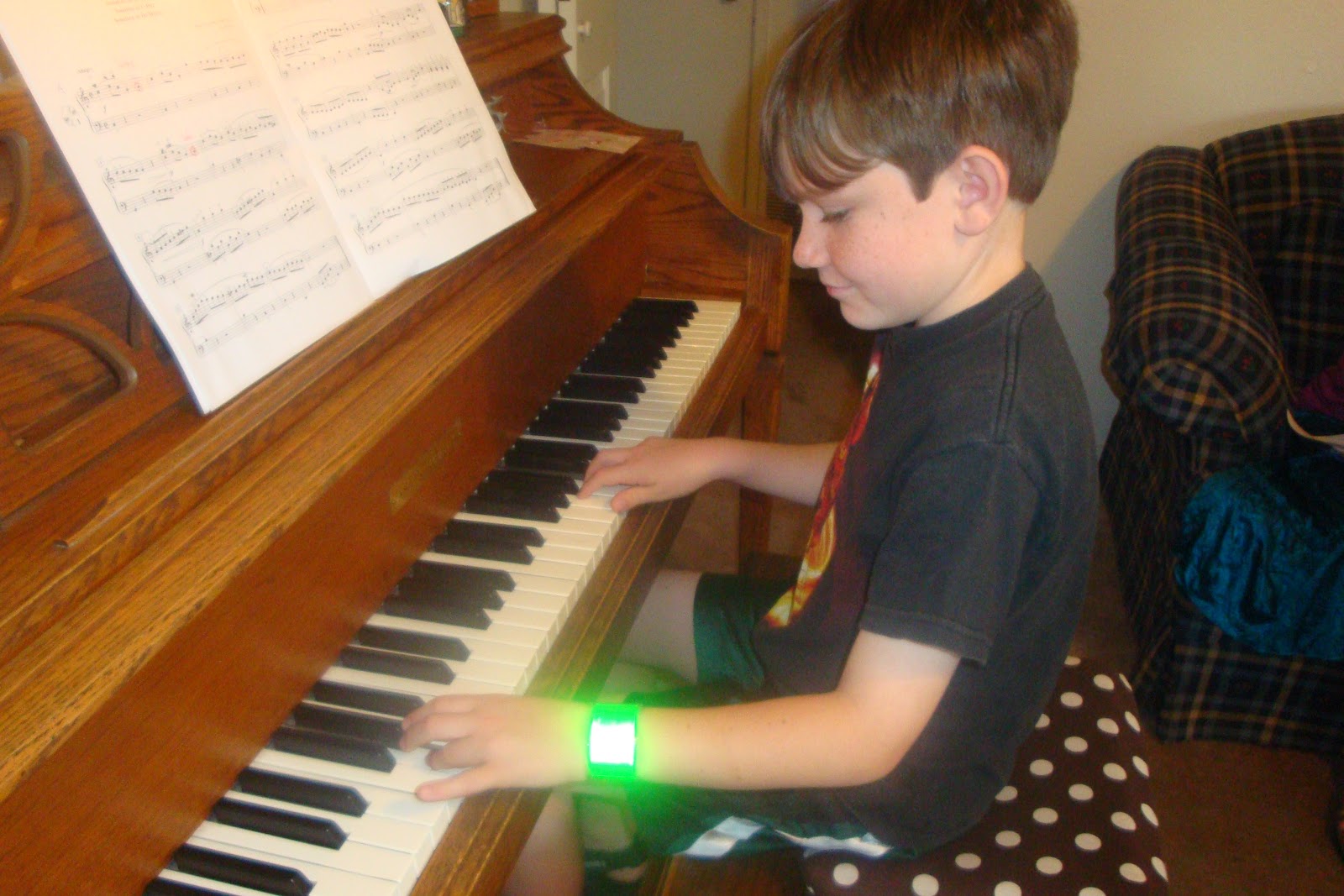
Bracelets - I looked for several weeks for those slap bracelets that used to be popular.  I just found them at JoAnn's in neon colors. 

Use bracelets to:
*remind wrist to stay up (as opposed to "don't let the wrist fall down"--always say the directions or reminders in a positive statement)
*remind the hand to bring out the melody or perhaps to play softer
*remind arm to relax
*practice a phrase or note pattern


Now how can I use these rings or bracelets to help ME with my problems?  Put rings on every finger so when I open the refrigerator to eat something I'll see them and stop?  Hmmm....I'll have to think on that one.


Thanks for reading,
 Cathy


********************************************************************************
 

LinkWithin

Related Posts Plugin for WordPress, Blogger...