Showing posts with label teaching children. Show all posts

Sunday, August 23, 2020

Parenting Tip - Might As Well Try!

 I heard a true story that has completely changed my attitude and actions.  This high school boy heard about auditions for a singing group that would be touring internationally.  He wanted to try out for it so he told his friend about it so they could audition together.  His friend said, "we're not going to make it.  Why even try?"  The first boy said, "Because we have already NOT made it right now.  But if we audition there is a chance that we WILL make it."  So they auditioned and made it!

I can't draw and don't know how to water color.  If I take a class, I'm not going to suddenly become Grandma Moses (a woman who became famous for her artwork which she picked up at age 78).  But you already can't draw and water color.  Taking a class will at least teach you the basics and get you going.

I want to teach ukulele classes again, but no one will sign up during this weird stage of COVID-19. You already are not teaching. Offer a class and see if anyone signs up.   (so far 18 students have signed up--I had to offer 2 additional classes!)

You don't have a green thumb.  You can't garden--everything you plant dies on you.  Why bother to wish for a new landscaped backyard.   You already have dead plants and an ugly backyard.  Take a class to find out why they die. Look up ideas for a backyard and follow their lead.  (I took an online class and found out about watering correctly, fertilizing and planting in the correct spot for the plant's needs.  I looked up ideas, got professional help and have received numerous compliments on my backyard).

Now when I want to try something new, I think about where I am at and how I already don't know how to do it.  But what is the harm in trying, and learning and growing.  It's invigorating and fun!!

My first sunflower!


learning to write with fancy fonts... 

one of my fairy gardens

Sunday, June 7, 2020

Parenting Tip - What Can I Do?

The last 3 months have been the strangest I have ever lived through.  I never thought in my wildest imagination that I would see the world shut down.  That businesses would close their doors.  That people would stay quarantined inside their homes for weeks and now months on end.  That my sons and son-in-law who live in 4 different states would be working from home.  That school marques would say, "School closed until further notice." That a pandemic the size of the whole world would bring the world intimately closer together.

And then, just as the world was beginning to loosen it's hold on the stringent methods it had to use to forestall the deaths of possibly millions of people, one person is brutally killed and everything is turned upside down again.

I have read many view points on the killing of the black man by the policeman and have wondered at the rioting, hate and crime that have insued.  I feel the pain of those people who are so often ridiculed, persecuted and unjustly accused and slandered.  I have felt embarrased and chastened by my own lack of understanding and ignorance of the racial issue.  I have pondered on what I can do.  Is there something that I can do to reduce the racial hatred that is consuming so many people? 

I am only one person and touch only a few people's lives.  My small pebble dropped in the pond only creates a small ripple.  But it does create a ripple.  It does move outward and who knows what other small ripples it may touch.

So what can I do? 

I can teach.
 My children are grown, but I have grandchildren and I can teach them to love and accept others who are different from themselves.  My nephew Bradley's wife, Kailei, posted on Facebook a list of books we can read to our children.  I borrowed one and read it to my grandchildren on Marco Polo today and bore my testimony that God loves all His children and made us different so we can help each other.

I can feel empathy.  A biracial family I know feels sad and threatened.  Wouldn't they appreciate someone recognizing their pain and hurt from past occasions and welcome a treat and note of love?

I can acknowledge another's humanness (yep, that's a word).  When I fly on a plane, I notice that the seats next to black, brown, Muslim, poor, and fat people are the last seats to get taken.  It is obvious that others are avoiding sitting next to them.  What if I chose to sit by someone different from me and acknowledged them?  What message would I be saying without saying a word?

I'm ready to look around and see what small things I can do.  I'm ready to listen to the still small voice whispher what small things I can do.  Because "by small and simple things are great things brought to pass." Alma 37:6

Thanks for reading,

Cathy
PS I chose to read this particular book to my grandchildren because of an experience I had several years ago and again just recently.  The Proudest Blue is about a young girl who begins 6th grade and wears a hijab for the first time.  Several years ago when I was teaching school, a mother came up to me on the first day of school with her daughter and said this was the first day she would be wearing a hijab to school.  She wanted me to talk to the class and explain a little bit about her daughter's new headwear so the children wouldn't make fun of her. I was happy to do this and happy to find out more of the reason for wearing a hijab.

And then recently, for the past 1 1/2 years I have been teaching English to women from Somalia who  all wear hijabs.  I have gotten to know these women and love them.  I admire their desire to dress modestly and respect their beliefs.

We are all different.  We are all loved by God. 


********************************************************************************


Monday, February 3, 2020

Parenting Tip-The Whining Child

I just spent 2 1/2 weeks babysitting my 21 month year old granddaughter.  It was so fun because she lives out of state and I don't get to see her very often.

My daughter plays in a string quartet and her quartet was performing and teaching in another state.
So I went with them to babysit during the times my daughter was rehearsing or teaching.  My granddaughter always cried when mommy had to leave, but here are two things I used that worked like  magic to help her be happy:
**SINGING!  Let's see, I wonder how many times I sang Twinkle, Twinkle Little Star, The Wheels on the Bus and Old MacDonald while driving in the car?  I would venture to say at least 100 times each!  I also made up songs and was often impressed with my rhyming skills, though no one else above the age of 21 months ever heard me to appreciate my talents.
**DISTRACTION  The name of the game with unhappy toddlers, even older kids, is to distract them.  I distracted my granddaughter by playing with toys, reading books, playing with play doh, etc.

When mommy wasn't teaching or rehearsing, her toddler was often whining at her.  This drives my daughter crazy because she does it so much at their house too.  So I decided to look up why toddlers/children whine and what to do about it.  All the articles I read agreed with each other.

Children whine because they don't know how to express their emotions and needs. They want someone to pay attention to them and they get frustrated when their needs are not met.  So they cry or start to whine.

All the articles I read about whining offered the same basic ways to cure whining:
1.  Understand that your child is whining for a reason.  Is she tired, hungry, sick, overwhelmed with too much stimulus, her scheduled has changed, late bedtime, teething, the list goes on and on and on.
2.  Explain what whining is and ask your child to say what he wants in a normal voice.  Then respond immediately.  This doesn't mean you necessarily give him what he wants (I understand you want to play longer, but now it's time to go home from the park.  Thanks for letting me know what you wanted), but if you are kneeling down looking him in the face, he knows you have heard him and at least have understood his needs.
3.  Spend quality time with your child each day.  Give her your full attention, hugs and kisses.  No phones or distractions.  Be in the present and enjoy your child.
4.  Look at your needs.  Are YOU stressed, tired, overwhelmed?
5.  One mother who blogged about whining cut out all screen time except on the weekend.  Instead of using screens as a babysitter so she could get something done, she used real toys and books instead. Be creative:  use kitchen gadgets as toys, recycled materials, pour rice with measuring cups into a bowl, water paint on rocks.

Some children whine more than others.
Some days/weeks are better/worse than others.
Some parents are more sensitive to whining then others.

But knowledge is power, and if you know what to try, even though all days won't be perfect, you will be more patient with your child--and yourself.


My next blog post will tell how I discovered I WAS WHINING, and to whom!


Thanks for reading,

Cathy

Friday, May 4, 2018

Parenting Tip - Be Inconsistently Consistent

I've noticed two main attitudes that develop in families when things get hard.  Either they quit doing the hard thing completely and let it drop, or they make adjustments, streamline the "hard thing" for awhile and then get back to doing it again.

I've seen this happen over and over again as I have taught piano lessons.  The family begins lessons with enthusiasm and commitment and practicing begins in earnest.  Then after a few months, LIFE happens.  Soccer games, illness, busyness in school and Church, financial problems--you name it, suddenly it becomes too hard to fit practice time in and lessons drop.

I've experienced this over and over again with family/personal scripture reading, Family Home Evening, and family prayers.  You have them consistently but then LIFE happens.  It becomes too hard to schedule them in because of late night games or teenagers are at work or your kids have too much homework, or Dad is out of town. And the scripture reading, FHE and prayers drop.

Life is full of HARD things.  But it is in doing those hard things, that real growth and benefit is acquired. So I propose:

                                                   BE INCONSISTENTLY CONSISTENT!


I've seen it with my piano families.  Those who keep on taking lessons and practice when they can, actually do make progress.  Example:  I teach twins in a family who is very busy raising pigs and goats and showing them at county fairs around the state.  When county fair time arrives, they have to miss a lesson here and there and they are so busy with travel, that practice time becomes 10 minutes instead of 30.  But they don't quit, they make adjustments and simplify, then get back to normal practice when the fairs are over.

Another example is my son's family.  My daughter-in-law has taught piano to some of the children, exchanged giving lessons with another mom and has even quit for awhile.  But when I visited them last week, I was amazed to hear my granddaughter and grandson playing popular music that was quite advanced.  In fact, my grandson is accompanying his school class at their Spring Concert.  By being inconsistently consistent with piano practice, these two grandchildren are enjoying piano and progressing at it.

What about scripture reading, prayers and FHE.  Each time we read and pray it becomes a thread we weave into our family's tapestry of spirituality. Some days,weeks,months we may be consistently weaving while at other times, the progress is slower.  But as we continue to try to be consistent, our pattern takes form and our tapestry grows in beauty and strength.

Teach your children to do hard things.  If you have to make a new chore chart, do it.  Give a pep talk, give it. Be a "mean" parent. Be it.

Teach yourself to do hard things.  If you have quit exercising and eating healthy, begin again.  My daughter has run 13 half marathons and 2 full marathons, but hasn't ran for two months.  Will she begin again?  Of course.  Life happened and she had to take some time off, but she is still a runner and will continue running in the near future.

Hard things are hard.  But they can be tackled, achieved, and overcome as we continue working on them.  We are not perfect and not expected to become perfect in this life.  But we can learn, acquire skills and progress as we step forward, fall back, then step forward again.  As we consistently keep trying amidst all our inconsistency, we are doing what we should be doing.


Good luck to all of us!

Thanks for reading,

Cathy


****************************************************************************


Wednesday, October 25, 2017

Parenting Tip - Is Your Child an Upholder, Obliger, Questioner or Rebel (read as Strong-willed)?

I really like many of the books Gretchen Rubin has written, but I’m obsessed with her newest book, The Four Tendencies.
This is what she says about it on her website:
During my multibook investigation into human nature, I realized that by asking the suspiciously simple question “How do I respond to expectations?” we gain explosive self-knowledge.
I discovered that people fit into Four Tendencies: Upholders, Questioners, Obligers, and Rebels. Our Tendency shapes every aspect of our behavior, so understanding this framework lets us make better decisions, meet deadlines, suffer less stress and burnout, and engage more effectively. The Four Tendencies explain why we act and why we don’t act.
I am an Obliger (you can take a quick quiz here to find out what tendency you are ).  Knowing this has made my life easier.  I understand why I do some of the things I do and know how to deal with other aspects of my life, like accomplishing goals or saying no to people.  I think it is important to understand our family members and realize their tendencies—especially our spouses and children.  It can make family life so much more enjoyable when we understand why people act and respond the way they do.  Then we can change the way we approach our spouse or child so we can have win-win experiences and less conflicts.

Here are the Tendencies in a nutshell:
The Upholder Tendency
Upholders are those people who readily respond to outer and inner expectations alike.   They meet work or school deadlines as well as keep goals they set for themselves.
Strengths:  Upholders can set goals and ideals for themselves and stick to it.  They follow rules. They also fulfill expectations that others have for them.  They love schedules and routines.  They like to know what is expected of them and don’t like to make mistakes.
Weaknesses:  Upholders don’t like to have their schedules changed.  They are uncomfortable if they can’t follow the rules or expectations teachers or others have put on them.  They want to follow them whether they are sensible or not. They don’t like change and can be inflexible and rigid.
Dealing with an Upholder Child
Parents may enjoy having children who are Upholders because they don’t have to nag them about doing homework or practicing the piano. They plan ahead and have their softball equipment ready and like to arrive at school on time or even early.

The Upholder child doesn’t like to change his schedule.  If he needs to read 30 minutes a day for school he has a hard time letting that go if a busy day prohibits it. He has a hard time letting a task go not quite completed such as a book report project he feels he needs more time on.

Be careful about unintentionally adding an expectation or suggesting unnecessary rules.  An upholder child will exert a lot of energy toward trying to meet it.  The author states that an offhand remark like, “you should enter the spelling bee” might set off an unintended stressful chain reaction.

In dealing with an Upholder child, address his tendency value: “You like to do things that are expected of you”, “you like to be on time”, or “you like to finish your projects”.  But then address the issue in a logical way such as, “your teacher will understand that you can only read 15 minutes on some days”, or “it’s more important to go the speed limit and be safe than to be extra early to school”.

The Questioner Tendency
We all have inner expectations—things we want to do, and outer expectations—what others want us to do.  Questioners only do things that are inner expectations and only those outer expectations that they have turned into inner expectations.  Questioners want information, logic and efficiency.  They want to gather the facts and decide for themselves if something is legitimate to do, the best thing to buy, or the right thing to follow. They like logical conclusions and will research options until they are convinced.
Strengths:  Once Questioners are resolved to do something, they follow through and are reliable. They don’t just accept the traditional way to do things, so may come up with new solutions to problems or situations.
Weaknesses:  When Questioners don’t accept the justification for an expectation, they refuse to meet it.  Rules may seem arbitrary or make no sense.  When wanting to purchase an item, they may research and question so much, they can’t come to a conclusion and make a decision.

Dealing with a Questioner Child
A child who is a questioner does not accept phrases like, “because I said so”, or that’s the rule”. Questioners want to understand the “why” of doing something, and once they do, they are more willing to comply.  Why is piano practicing important?  Why should I learn the multiplication tables? Why does my school require uniforms?

Parents or teachers who are dealing with a child’s refusal to do something should find out why the child is refusing, then help the child understand the reasons behind the issue.  Help him find the justification for doing what he doesn’t want to do.  Why do I have to sit in my car seat?   Because it’s the law and you don’t want Mommy to have to pay a fine.  Why do I have to eat my vegetables?  Because they will make you healthy and strong so you can hit a home run some day.

The Obliger Tendency
Throughout a day, week and month, people are always asking us to do things.  The Obliger can accomplish things someone else asks her to do, but has a hard time meeting expectations that only she puts on herself.  For example, when you were in school, you could meet your English deadlines, but now you have a hard time consistently writing in your journal.

Obligers needs accountability.  Someone who is expecting them to bring them the results they’ve asked for.  If you are on a team and training for a game, you don’t want to let your teammates down, so you run every morning.  But after the season is over, you can’t get yourself to run anymore.  The accountability has disappeared.
Strengths:  Obligers get things done!  They volunteer, help out, and meet deadlines.  They make great leaders, team members, friends and family members.
Weaknesses:  Obligers have a hard time meeting their own needs and desires.  They need to feel accountable to someone in order to meet the goals they’ve set for themselves.  This is my tendency.  I used to always announce to my children that I would give them $10 if they saw me eat any more cookies the rest of the day.  Then it was easy for me to not eat any more.

If Obligers get overwhelmed by constant demands they are trying to meet of others, they can have a meltdown—which is usually not pretty.  They go into Obliger-Rebellion and resist doing anything.   Family members need to be aware of Obligers in their home, and help them not get overwhelmed, by helping them say “no” when necessary.  They can also provide accountability to help them reach their goals.

Dealing with an Obliger Child
I was delighted to read the author’s example when dealing with an Obliger child (which she says is sometimes hard to pick out).  She gave the example of piano practicing and said there needs to be accountability like having a practice chart, a parent’s gentle reminder or a teacher who says, “I can tell if you’ve been practicing or not.”

Help your Obliger child create accountability by enrolling him in classes, making job charts, having family rules, etc.  But be aware so your child does not begin feeling overwhelmed by meeting everyone’s needs but his own.

The Rebel Tendency
Rebels don’t want anyone telling them what to do, including themselves! They resist all efforts when someone asks them to do something and have a hard time getting themselves to do something they want to do.  For Rebels, being able to choose and have freedom of self-expression is vitally important. They respond better to people asking their opinion rather than being told to do something.
Strengths:  They don’t cave into peer pressure.  They enjoy meeting challenges especially when someone says it will be too hard to do. Rebels do things their way and want their lives to exhibit their values.
Weaknesses:  Rebels don’t like to be told to do something and resist commands and control over themselves.  They want to do things in their own way and in their own time.  They have a hard time sticking to a schedule.

Dealing with a Rebel Child (my daughter prefers to call them Strong-willed children and I agree)
Strong-willed children are hard to deal with. They want to make their own choices.  The best way to handle them is to give them information, tell them what the consequences are, and let them make their choice. And don’t watch them—then they think there is an expectation and will rebel and not choose.
Strong-willed children need to feel the consequence of their choices, be it good or bad. Strong-willed  children are motivated by identity.  Explain the situation:  “When you’re always late and delay our leaving, I feel like I can’t trust you.  Do you want to be trustworthy or not--your choice."  Make things fun for the strong-willed child.  Make up games when you’re brushing your child’s teeth or sing silly songs.  Strong-willed children like challenges: “Bet you can’t get dressed before Daddy does”.  Let them choose: “You can eat a snack, do your homework now, and then play before dinner or you can eat a snack and play first.  But if you don’t finish your homework before dinner, you will have to finish it after dinner and not have time for me to play a game with you before bedtime.  It’s your choice.” Then allow them time and space to make their choice.

In reviewing how to deal with children in these four tendencies, it seems to me that parents should use lots of common sense.  It shouldn’t be a nerve wrecking decision trying to decide what is the correct thing to say to your obliger child compared to what to say to your strong -willed child.  Good parenting  techniques cover all types and personalities of children.  In summary, here are some basic, sound ideas that work well in dealing with any and all types of children:

1.       Explain the situation to your child when a conflict arises.  Appeal to his sense of value.
2.       Listen to your child to understand what his needs are that are not being met.
3.       Explain the “why” behind rules and “why” you are asking for a certain behavior from your child.
4.       Make charts and give positive reinforcement to help establish new habits and outcomes.
5.       Give information, consequences and choice to your child.
6.       Let your child suffer the consequences of his choice and actions.
7.       Have fun with your child, make up games and challenges to spice up daily routines.

I hope this information has been helpful.  Now apply it to your spouse!

Thanks for reading,

Cathy
******************************************************************************


Monday, October 23, 2017

Parenting Tip - Strengthening our Kids for the Last Days


This is a great video that gives practical advice to parents who are raising children now.  And preparing them for the future.

Where are you spending your time?  Where are your children spending their time?  Too many activities?  Not the BEST activities for this crucial time in their lives?

How can you get protection for your children?  How can you open the other POWERS that are available?  How can you access the "other side" of the veil to strengthen and help you.

How can you utilize the Sabbath Day?

Great insights and support and help for parents in this, the last days, as we prepare our children to usher in the coming of the Lord.

Thanks for reading--and viewing,

Cathy

*************************************************************************

Thursday, April 20, 2017

Parenting Tip - Teaching Children to Feel the Spirit

There are so many things to teach our children, it can be overwhelming at times.
We may ask, "What are the most important things to teach?  How can I fit one more thing into my schedule?"

Read this article:  Learning the Language of the Spirit: 7 Teaching Tips for Parents and see how you can dovetail this type of learning with your everyday living that you already do with your children.

Thanks for reading,

Cathy
*******************************************************************************

Sunday, January 29, 2017

Parenting Tip - Modeling

I was babysitting Bromley, my 2 year old grandson, when he found a book lying on the floor.  It was a thick book with lots of pages and no pictures in it.  He opened the book, turned some pages, then closed the book and folded his arms and bowed his head and say, “prayer”.  He waited for me to say a short prayer, repeating some of the words, then he opened the book again, turned some pages, then closed the book again and folded his arms and bowed his head and say, “prayer” .  We went through this whole scenario 5 times in a row!

When my daughter came home I told her about it and wondered what was going on.  She exclaimed, “He was reading the scriptures!”   She said for the past several weeks they had consistently been reading the scriptures, then saying their family prayer afterwards.

Wow, what a great model my daughter and her husband were giving for their son to follow.  It got me thinking about modeling and how that can affect our own actions.  A friend of mine from childhood moved back in with her parents, who lived down the street from me, when her parents became ill and unable to care for themselves.  She modeled great love for her parents and the importance of taking care of them in their older years.  When my mother in law became sick and unable to live by herself, my husband and I invited her to come live with us.  We had seen great examples of children caring for their aging parents modeled to us and we followed and wanted to do the same.

What kind of modeling are we doing in our homes with our children?  We usually don't even think about what our actions are saying, but we know that actions are like a picture-- worth a thousand words. 

How do we model unconditional love with a rebellious teenager while a younger sibling is watching?
How do we model patience when potty training a three year old with the five year old watching?
How do we model forgiveness when our two year colors with crayons on the newly painted wall?
How do we model longsuffering when everyone in the house is sick, including you?
How do we model respecting others when your daughter rants about her _________ math teacher?
How do we model honesty when we find we weren't charged for the french fries we bought with our hamburger?

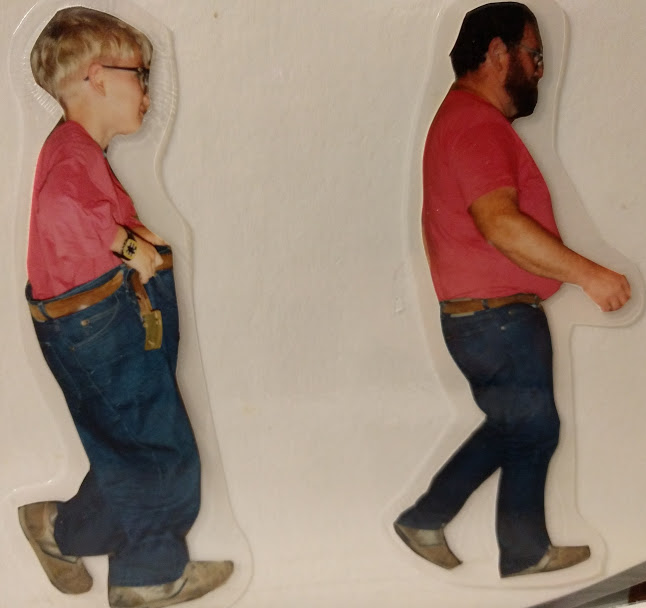
Many years ago I made a photograph book for my son illustrating when he liked to wear his Daddy's shoes around the house.   Each page shows 
him wearing one of his Dad's shoes, like his work boots, Sunday shoes, fishing shoes, etc.  These are the last two pages: 
I know it's hard for me to walk and keep these shoes on right.
So I'll follow Daddy's footsteps as he guides me in the light.
Choose who you look to for a model carefully, and remember who is watching YOU.

Thanks for reading,

Cathy
***********************************************************************


Tuesday, September 20, 2016

Parenting Tip - "But it's so hard!"

I was teaching a music class with a group of children who have autism.  We had a song about following directions and had done several activities during the class time having the students practicing following musical directions. As I summed up the class I reminded the students to try and follow directions the rest of the day.  The teacher then asked the students to pick up their chairs and take them back to their desks.  Marshall did not do this and the teacher said, "Marshall, didn't you just learn about following directions?" Marshall responded with a frustrated voice saying, "but it's so hard to follow directions!"

Don't we all feel that sometimes?  It's hard to follow directions whether it's how to install a program on our computer or a complicated new recipe, or even helping a child with his math.

Children feel the same way, of course.  So how can we help them learn this invaluable skill?  We can try to think and feel as a child.  We can use our imagination, use games, toys, music, and play to make it fun. We can use incentives or set family rules and be consistent in following them.

Time to get in the car and the fight to get the seat belt buckled starts?  Try some imagination: "Hurry, hurry, here come the tickle bees.  Get in the car and get buckled before they start tickling you!"
OR
"Hey, Mister Bus Driver, are you going to drive this bus?  Get in and get buckled and start your wheels goin' round"

Toys all over the floor?  Play a game.  My mother was a master at playing army and giving commands to the soldier grandchildren. She would salute each one, give them a specific thing to do (pick up all the blue toys), then have them report back to her for their next assignment.

As a mom, I wasn't in the mood to play games, I just wanted the bedrooms cleaned up.  But I was willing to make it fun, .  So I would hide M & Ms under books, clothes and toys on the floor and tell my kids they could eat the candy they found, but they had to put the item away first.  Worked like a charm!

Time to practice the piano?  Give incentives for following directions to "get in there and practice".  Do your child's chore while she practices (I don't know how many dishes I washed for my daughter when it was her turn to wash, but she still needed to practice the piano).

Other incentives could be, "let's read library books when the toys get cleaned up" or "after your homework is done you can go out and play".  An incentive to clear the table or wash the dishes quickly after dinner when I was a kid was this family rule:  if you get all the dishes washed before the person whose job it is to clear the table gets finished clearing, then they have to wash those dishes.  I caught my brother only a couple of times on this rule before he learned to do his job before starting to play.

Here's a tough direction to follow:  be reverent during Church.  Remember, this is an ongoing learning situation and different age groups will be better at it than others.  But try this family rule:  if you are not reverent in Church, you need to practice being reverent when you get home. Put Church music on and have your child sit quietly on the couch for one or two songs (or more, depending on their age).  You as the parent may need to sit with your young child or even hold him on your lap while listening to the music and practicing being reverent.  Keep in mind the child's age. Perhaps a 4 year old would sit for 4 minutes while a 10 year old would sit for 10 minutes. This would not be appropriate for a one or two year old. They would not connect the events from Church to couch sitting.

Following directions.

Yes sometimes it's SO HARD!

But what a valuable skill and habit to learn--for adults and children!

Thanks for reading,
Cathy
******************************************************************************

Friday, August 21, 2015

Parenting Tip - There's a War Going on!

Yikes!  There is a war going on.  Right now!  This very minute.  And you and I are in the war-- so are our husbands, and our children.  In fact, that is what the war is about.  FAMILIES!

Families are disintegrating. Families no longer eat together, or even talk to each other. Young married couples are choosing to have pets instead of children.  Yes, dogs are replacing children for many mothers.  Single parent families have become the norm.

This world is a scary place--a very scary place to bring innocent children into. Newly married couples wonder:
Should I have children?
What will happen to my children? 
How can I raise them to be responsible, well adjusted adults? 
What can I teach them that will help them embrace the truth instead of all the lies that will be thrown at them?

The answer lies in teaching children WHO THEY ARE.

When you  know who you are, it is much easier to hold on to that truth and use it as a guide as you wade and sift through all the lies, distraction and allurements that the media is constantly enticing you with.


Teach your child these simple truths:
* You are a child of God. He loves you unconditionally.
* You lived with Him before this life and He wants you to return to live with Him after this life.
* God has provided a family for you to grow up in.  A family loves you unconditionally.
* A family helps you learn how to act and love and serve others.
* God created you for a purpose.  Find out what that purpose is.
* Live your life according to God's word and you can return and live with Him.  
* Be kind. Serve others.

We need to teach our children that this life is only part of a larger, bigger picture.  It is the 2nd Act of a 3 Act play.  They need to know what happened in Act 1 (we lived with God) and what will happen in Act 3 (we will return to live with God if we have lived righteously on earth).

When a child understands who he is and why he is on earth, his choices take on more meaning.  

Life takes on more meaning. 

And that war that is taking place..... well it takes on more meaning too.  But  now we'll be up for the challenge, for we, and our family members, will be armed with knowledge.  And Knowledge is Power!

Thanks for reading,

Cathy
********************************************************************************


Sunday, May 3, 2015

Parenting Tip - The Hands-On Approach

My husband's birthday was a couple of days ago.  He has been gone almost 4 years now, but his legacy still lives on.  One of my sons asked his daughter, who just turned 10 years old, what were some of the best things she remembered from her "decade" of living.  She immediately replied, "Going fishing with grandpa!" 

You never know what impact you make on others until later.  When I look at how my sons parent, I think of their Dad.  He taught them well.

My husband taught through a "hands-on" approach. If the oil needed changed in the cars, my husband had our boys help him.  Later they did it themselves.  If there was a plumbing problem, my husband enlisted the help of one of our sons.  They learned by doing, not just watching.  I wasn't aware of how powerful that teaching was until my husband passed away.  Then as we talked as a family, each of my sons reminisced and told stories of helping Dad fix this or that and how much they had learned from him.

All my sons are married and have children of their own.  They all live in different states from me except for one.  Jacob lives close by and it is so rewarding to watch him parent his own 3 sons.  He, too, is a hands-on Dad.  He takes them to Home Depot with him, not only for the classes, but when he goes there to buy things.   He found out about a new place downtown where you can use lathes, lasers, and other types of machinery to make your own projects for free.  That would sound like a scary, over the top kind of place to take your young children, but not for Jacob.  He took two of his boys and they loved using the tools and making things.

 A couple of weeks ago, my grandsons were so excited to tell me about the garden their Dad was making.  It turns out that my son cut up an old wooden table that my father-in-law had made years ago and built a raised garden bed out of it.  I'm sure my husband and father-in-law were beaming to know that their son/grandson had used something of theirs and had the know-how to make it into something else useful. 

One of the most important things my husband taught with his hands-on approach to learning was how to pray to the Lord and ask for blessings and thank Him for blessings given.  Last year my son invited me to go with him and his two sons to an airshow.  On the way there, we were involved in an accident on the freeway.  My two grandsons immediately began to cry, and Jacob jumped out of the car to open their door to see if they were hurt.  They weren't, so Jacob said, "Let's say a prayer to Heavenly Father telling him thank you for blessing us that we are okay."  What a thrill that was to my heart to see that immediate reaction come from my son.

We learn by seeing, by watching, but most importantly, by doing.  Be a hands-on parent.  Give the wonderful gift of independence to your children by having them work with you, clean with you, cook with you, play with you and---pray with you.

Monday, February 16, 2015

Parenting Tip - Go Ahead and Use That Cell Phone!

Technology is here to stay and it just keeps getting better and smarter.  We can stay in the dark ages and fall behind the times, we can worry and fret about the bad uses of technology, or we can educate our children (and ourselves) and use technology!

I could not see the advantage of having a "smart phone" and was content to keep using my old cell phone.  I have a computer at home, I teach from home and I stay at home quite a bit, so why not just use my computer for all my internet needs?  But my children and friends told me once I bought a smart phone, I would immediately see the advantage and wonder how I got along without it.

They were right!  I LOVE my smart phone and use it all the time, especially to stay in touch with family and friends.  But I also use it when I teach piano and music classes.

I especially LOVE to use my phone when I'm around my grandchildren.  I take way too many photos and videos of them, but it's so easy to delete the ones I don't want, and it's so fun to utilize the ones I do want.

Not only is the camera fun to use on a cell phone, but I love using the video recorder and voice recorder.

Here are some ways I've taken technology and used it to enhance my fun--yes my fun!
Video recordings of:
1.  my grandchildren digging holes in the back yard, putting on puppet shows, dancing, coloring with chalk on sidewalk, singing
2.  my 92 year old father telling stories of his childhood on his dairy farm 
3.  my grandchildren making a "how to" video, such as "how to make a peanut butter sandwich"
4.  my piano students playing a piece, then uploading it to my private you tube channel so their family and friends can see it
5.  my banjo teacher showing me a new lick to learn on the banjo
6.  Church children singing a song that I sent to a sick teacher
7.  and of course, a million jumping on the trampoline stunts!

But here's the thing I love about using videos and having your cell phone so accessible.  You can use it to STOP TEMPER TANTRUMS, KEEP KIDS QUIET IN CRITICAL SITUATIONS, OR _________________ (you fill in). 

 
Scene: Grandson, Tac, is playing the piano, but grandson, Asher wants to play it. Tension is building!
Dialogue--- Me: [Look how Asher's] waiting patiently.  Notice he's not crying.  He's frustrated and he wishes his brother would hurry up but he's patiently waiting. 
Asher:  No, I'm not!
                                               (Well, at least he's not crying and hitting his brother!)
IDEA:  Video record or snap a picture of your children doing what you want them to do.  In other words, be positive and focus on the short times you catch them doing what they should be doing or encourage them to start doing it by video taping them.  How about when your children are picking up their toys, brushing their teeth, getting dressed, or practicing an instrument or doing their homework.  Send the video to Dad or grandma.  Make a slide show out of photos.

Here are some ways I've used Voice Recordings:
1.  My text notification is my grandson saying "grandma, you've got a text, grandma, you've got a text"
2.  Me playing a piece on my banjo.  It makes me nervous to record myself, but it helps me get over my nervousness when I record myself several times in a row.  It's a great way to practice for a recital or performance.
3.  My grandson saying words.  He is delayed with his speech, and this is a fun way to help him  practice saying tricky words.
4.  Music groups rehearsing for a performance.

IDEA: Record your child saying his spelling words, reciting a poem, playing a piece of music on his instrument.  Record yourself quoting a scripture you want to memorize, or a mantra to help you during the day.  Record your baby or children laughing.
 So go ahead and use your cell phone.  But make sure YOU are in control of it, not IT in control of you.  Use it for good and worthwhile purposes such as bringing loved ones far away closer to you, or as a teaching tool or as positive reinforcement.

What are some ways you have used your cell phone to help yourself or your family?

Thanks for reading,

Cathy
*********************************************************************************

Sunday, September 21, 2014

Parenting Tip - You DO Make a Difference

For all mothers and women, and men, and....... and sisters and cousins.  For all of us.  This message will bring you comfort.


Maybe this mom didn't make the same choices you would have made, but we have all been where she has been and had those kind of days.  The key is to have the Spirit with us to know when to say "yes" to someone else's need or when to say "no" and put our needs and our family first. That's the hard part, knowing what choices to make.

But it's comforting to me to know that Heavenly Father cares about the "one".  So if we can help ONE, then we are choosing the best choice.  And sometimes that ONE will be yourself.

Thanks for reading,
Cathy

********************************************************************************

Wednesday, June 11, 2014

Parenting Ideas - Summer Time!

Summer time, oh, it's summer time......

I've been asked to teach a class at church on ideas for summer fun.  I decided to post some of the ideas here.

Free/Cheap kid play activities:
Super bubbles!
6 cups water
1 cup light corn syrup
2 cups Joy dishwashing soap (If using an ultra concentrated dishwashing liquid, use only 1 1/3 cups) 
In a large bowl (at least 3 quarts) stir water and corn syrup until combined.  Add dishwashing liquid and stir very gently until well mixed.
(Try not to make any bubbles.) Dip (don't stir) bubble wands into bubble liquid and blow bubbles.

Snake bubbles
Cut bottom off a water bottle. Duct tape old sock to cover bottom opening.  Dip sock in solution of dish soap mixed with a little bit of water.  Blow through mouth end of bottle and see the long snake bubbles that appear!

Paint:
rocks 
with water and brushes outside 
water color

Stores with free activities:
Bass Pro Stores Outdoor Kids Night! Tuesdays 5-8pm free kid activities
Home Depot, Lowes - Saturday free craft - check local stores for details
Fiesta Mall Thursdays 1-2pm at Center Court

Reading Programs to earn free books or prizes:
Barnes &Nobles
Pottery Barn
Pizza Hut
Local Library
Scholastic and Sylvan online activities 

Discount Movie passes:
Cinemark and Harkins Theaters

Children's Museum of Phoenix
Target Free First Friday

Things to do with food:
Mini marshmallows and pretzels (or toothpicks) - build geometric 3 D shapes
playdough - look up on pinterest
Assign older children to make breakfast/lunch or dinners
Lots of healthy snacks=happy children

Water Activities:
Splash pads at theaters, malls
Homemade slip n slides/sprinklers
Duck, duck squeeze (like duck duck goose, but squeeze sponge full of water over head)
Water in buckets/bins.  Add soap, give kids egg beaters (find at thrift stores) and watch the fun!

Summer Focus - Help children make goals to:
learn something new (sew, crochet, use drill, hammer)
practice something (cooking, musical instrument, art)
read certain number of books
create/invent something
work on scouting 
family service project

Organize your summer
Weekly focus (reading week, learn something new week, craft week, watch Disney movies week)
Daily centers (chores, reading, free play, sibling/friend play, practice time, crafts, snack time, quiet time)
Pair up older children with younger children to help with chores, playing, learning

Collect "junk" and let children create, create, create.  Play background music.
Make marble runs with toilet paper tubes

Teach children to entertain themselves or play with siblings.  Have a rule "If you're bored, you get an extra chore!"

 Go on pinterest and find some fun activities. Type in these ideas to find hundreds of ideas:
*playdough
*light boxes
*marble runs
*children's books
*children's art activities
*water play
*children and food
*children's crafts

Emphasize something your child is good at or interested in.  If your child likes dinosaurs, do lots of reading, writing, looking at and playing with dinosaurs...or rocks.....or American dolls.....or whatever!  Encourage your child to explore his interest and learn as much as there is to know.

Last idea:  do what someone on facebook posted:    Make a goal to simply 

survive summer!


But what a waste of 2 good months.


Thanks for reading,

Cathy

 Check out this website for free things to do in AZ 

********************************************************************************


Thursday, February 27, 2014

Music Tip - The Triangle

I just received a nice comment from one of my subscribers (thank you Master P), so I decided to check out a couple of her blogs.  Since she is a musician and teacher, one of her blogs is about helping her own children practice and ideas on how to motivate them.  Today she posted a "scathingly brilliant" (know what movie that is from?  Anne of Green Gables, I love that phrase!), idea for practicing and a very sound learning principle behind the idea.

I don't want to take away her thunder, so you'll have to check it out, here.  It is a very true principle.
Also scroll down and read the idea about chocolate chips practicing.

Now here comes the point to my post today.  I, as a piano teacher, feel like my job is to teach, encourage and motivate my students to practice.  I enjoy doing that, in fact.  

BUT....I'm not the reason your child will learn to play the piano; it will take a triangle for this to happen--- Me--the teacher, you--the parent, and your child--the student.  Together we can create a musician.

You--the parent, are VITAL to this triangle.  You can't just "wish" your child to play the piano.  You can't even just "pay for piano lessons" and have your child learn to play the piano.  YOUR CHILD HAS TO PRACTICE THE PIANO. 


You--as the parent, have to provide enough time in the day for your child to practice. That sounds simple, but read that statement again.  

t h e r e  h a s  t o  b e  time  t o  p r a c t i c e. 
Think about it.

You--as the parent, have to help motivate your child to practice.  You have to be involved.  You can't just provide piano lessons, you have to help make learning it, happen.

So, there you have it.  Me.  You.  Your child.

It's a journey all 3 of us are on together.  Let's have fun on the journey!  Let's be creative!  Let's enjoy it---cause let me tell you, music is a gift from God, and it is one of the most beautiful gifts He has given us.  

Let us say, "thank you" by using this beautiful power to enrich and bless our lives.

Thanks for reading,
Cathy


******************************************************************************


Thursday, October 24, 2013

Parenting Tip - Do Not, I repeat, Do Not Overschedule Your Children!

I was talking with another piano teacher who told me that one of her students is blind.  She mentioned that his caretaker brings him to lessons and sits in another room waiting for him.  Her student never progresses and she was feeling frustrated one day at his lesson.  Finally, she asked him when he practiced--when in the schedule of his day did he find time to practice the piano.  He replied in astonishment, "you mean I'm suppose to practice at home?"

The teacher asked him about his day's schedule to try to help him find a time to practice but he said he was always busy.  She went and talked to his caretaker about his piano practice and she answered the same as he did, "you mean he's suppose to practice at home?"  After talking with the caregiver she realized that he had no time at all to practice the piano at home.  He went from one activity to another after school until it was time for bed.

I have had piano students do the same thing and I feel like shouting to the parents, "What are you doing??????  What are you teaching your child?"

This is really a pet peeve of mine--overscheduling children.

I've tried to look at it from the parents' perspective and know they have their children's interests at heart.  They are probably trying to enrich their children's lives, expose them to different kinds of activities and help them develop their talents.  But instead, too often, they are teaching them wrong principles.

They are teaching them:
*  I can do it all.  I'm a super kid and I can be good in sports, be in gymnastics, learn a musical instrument, swim, etc.

*  I deserve to do it all because my friends are doing it all.

*  I can do it all without practicing.  I can show up to rehearsals, lessons and that's all that's required of me.  I don't understand the concept of daily practice to become more proficient.

*  The Law of the Harvest--what you grow, you reap--what's that?  I just show up, then leave and don't really get good at anything.

*  I'm here to be entertained.

 I understand that parents want their children to be well rounded, be able to compete with their friends at school, and to develop talents.  They want them to have the life they didn't get to have, the lessons they missed out on, the talents they wished they had.  But unfortunately, it doesn't work that way.

So what do parents do?  Can't your children take any lessons or experience any new classes?  Yes, of course, but there is a balance to life.  You can have your child take gymnastics or be in the after school choir or be in sports, but it doesn't have to be all at the same time.  One summer do gymnastics, one semester be in the youth choir, choose one season of sports.  Then if your child shows an increased interest in one area, choose it for continued lessons and daily practice to help your child develop a talent in that area.

Your children need time to be home with their family.  Time to do their homework without rushing through it at the last minute.  Time to sit down with the family and eat dinner.  Time to help out with family chores.  Time to play with younger siblings.  Time to read books.

Don't put your child through a rushed childhood.  Let him enjoy being a child.  Playing, imagining, swinging outside, writing with chalk on the sidewalk.  Riding his bike, skating.  Talking with you.  Laughing.  Snuggling.  Enjoying life. Loving you.

Give your child a happy childhood.

Here are just a few of my happy grandchildren.  I'm so glad their parents are balancing their activities and giving them a happy childhood.


Thanks for reading,

Cathy

****************************************************************************


Thursday, May 30, 2013

Music Tip - Pete the Cat Books

Have you heard about or read Pete the Cat books?  I had never heard of him until I visited my grandkids in Utah.  One day someone in the family said something--can't remember what--- then all of a sudden the whole family started singing a funny little song.  I found out the song was from one of the Pete the Cat books.

I decided to investigate and this is what I found out:  Pete the Cat books are famous!  And cute! Some have songs in them, and Pete teaches something in each book like colors, numbers, being a good helper, etc.  They tend to be written for toddler to early elementary grade children.

The website at Harper Collins Children's  has a lot of fun activities to do in connection with Pete.You can learn about the author/illustrator, read about the books, download free activity pages and download the songs for free as well. 
 

Check out Pete on You Tube.  Several of the books are read and sung.  Your young children will love Pete!

Thanks for reading,

Cathy

***************************************************************************


LinkWithin

Related Posts Plugin for WordPress, Blogger...